
Year 10: Circle theorems
 Back to tutorials
Circle geometry appears often in Australian Year 10 exams. You need to know a few standard facts about angles, tangents, chords, and cyclic quadrilaterals, then apply them one step at a time.
Radius and tangent
If a line touches the circle at exactly one point, it is a tangent. The radius drawn to that point of contact makes a right angle with the tangent.
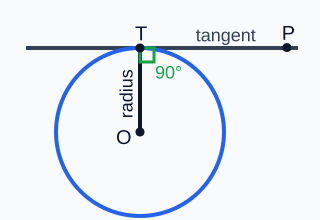
The diagram shows the standard fact used in many circle questions: the radius to the point of contact is perpendicular to the tangent.
- A radius to the point of tangency is perpendicular to the tangent.
- So the angle is .
Angles in the same segment
When two angles stand on the same chord and are on the same side of it, they are equal.
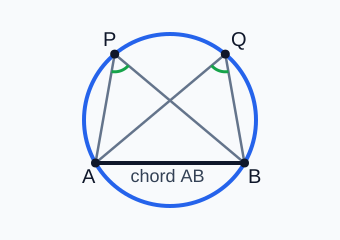
Both angles stand on the same chord , so they are equal. This is one of the most useful angle facts in circle geometry.
- Both angles stand on the same chord.
- Angles in the same segment are equal.
- The second angle is .
Cyclic quadrilaterals
A cyclic quadrilateral is a quadrilateral with all four vertices on the circle. Opposite angles are supplementary.
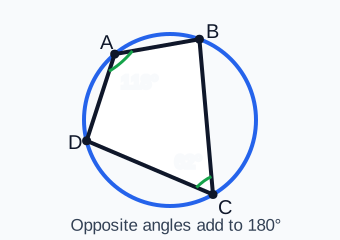
In a cyclic quadrilateral, opposite angles are supplementary. Here .
- Opposite angles add to .
- Unknown angle .
Working from the diagram
In mixed circle-theorem questions, start by writing the theorem you recognise beside the diagram. Then use that result to unlock the next angle. This stops the problem from feeling random.
Common mistakes
- Using the cyclic quadrilateral rule on shapes that are not stated or shown to be cyclic.
- Confusing a tangent with a secant.
- Guessing an angle from the picture instead of naming the theorem.